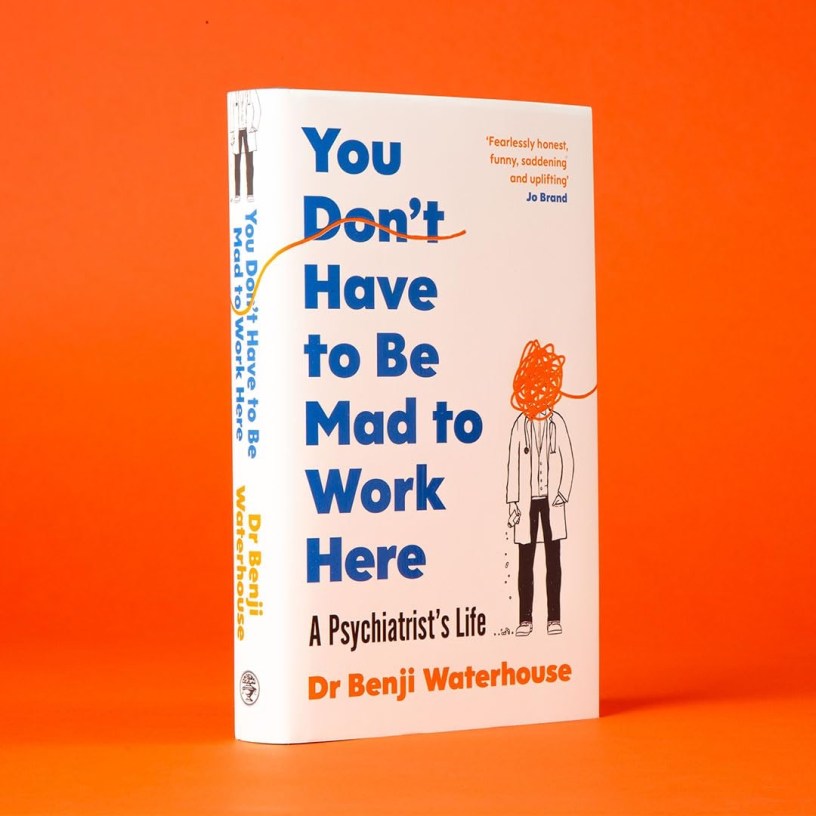
I love a memoir. And growing up in a medical/services household, I particularly love a memoir that focuses on high-pressure, high-stakes environments and professions, like prisons, hospitals, police, paramedics – so when I saw You Don’t Have To Be Mad To Work Here available on NetGalley, I thought it would be right up my street.
In the spirit of full disclosure, I almost gave up in the first couple of pages. In the opening, Dr Waterhouse makes some comments about ‘milder, more palatable’ mental health and neurodivergent conditions. He references ‘anxiety, depression, OCD, Autism and the increasingly diagnosed ADHD’ (also known as the ‘until now chronically underdiagnosed and mostly affecting women, ADHD’), and then goes on to say that this book is not about those people, rather it is for ‘the ones for whom some coldwater swimming and mindful colouring in probably won’t cut it.’ I’m not going to into why I think this is an inappropriate and reductive comment to make, as I think it’s probably obvious. While I do understand the point he was trying to make, that mental illness is less ‘palatable’ the worse it gets, there are better ways to do it than creating competition between some of the people who already face tremendous struggles because their conditions aren’t ‘severe’ enough to be taken seriously. Or those who struggle every day with neurodivergencies who are then compared unfavourably to people who have other, also distressing conditions. It shouldn’t be a competiton. Ironically enough, colouring in doesn’t help millions of people who suffer with OCD the world over either, if only it did. Suffice to say I was disappointed to see a psychiatric doctor say this in the name of entertainment and engagement and I put the book down for a while before deciding whether or not I could see past that comment to give it another go. I did – hence the big gap between start and finish dates – and my review is as follows:
Dr Benji Waterhouse is a newly qualified psychiatrist, and we meet him when he is a junior doctor getting to grips with the challenges faced by staff in an overstretched, underfunded NHS hospital. The first thing that becomes apparent is that there is a big shift to come with the optimism that Benji has when he arrives and begins to understand the severity of the disconnect between the ideology that the text books and university lecture have taught him, and the reality of working within a budget, with limited resources, not to mention being responsible for, real life patients. While Benji begins to grow in confidence and expertise, his frustrations rightly grow and he ends up having to go to therapy sessions himself. His own therapist seems to be completely inadequate and inappropriate, being late all the time and falling asleep in sessons, and I felt this was hammed up to add a bit of light entertainment, but if it was, for me it didn’t work, it just annoyed me. As we get deeper into the book it seems that Benji does have some serious issues that need to worked out, probably stemming from his less then idyllic childhood, and his resulting sense of self-worth, this is further illustrated by him keeping at a relationship with someone who doesn’t seem to be very good for him, and largely ignores his needs to focus on her own. Again, I’m not sure if this is exaggerated, and I think it maybe is meant to be funny (?) but it just fell flat for me and gave me a sense of him being a person who just can’t tell people what he wants, or puts up with levels of disrepect that end up winding him up so much he almost, almost, resorts to violence. I hope this is exaggerated and he does get the help he needs.
I did enjoy the descriptions of cases and the poignancy of some of them – especially the ones including Tyson the dog. An animal can truly be our best friend in the darkest of times. I also found the recounting of the moment when Benji caught a news story on the TV and recognised the description of the perpetrator – that was terriying, and really does illustrate what horrors can happen when mental health services are so stretched and underprioritised. People can and will be hurt, and careers will be destroyed. It must feel like living under the axe at times.
I think this book is a bit of a contradicton really. In some parts it’s funny and poignant, but on the whole it falls a bit flat for me. The humour is somehow ‘off’, it feels a bit too try-hard and comes across to me as a bit sad for it. I felt bad for Benji, and unsurprised that he was feeling unfulfilled and unhappy. On the whole, I think if you are interested in the challenges faced by mental health professionals and how it can affect them on a personal level, then you’ll find it interesting – and probably quite a frustrating read. There are lots and lots of footnotes, which are excellent at explaining what’s going on, but also break up the flow of the book in quite a distracting way – so if you’re no good at dipping in and out, you may find this a challenge.
Available from 16 May, published by Vintage Digital.

 Urban Bookworm